Field Notes 4.—The Fröis Arms
A study in family, place, and inherited symbols
There are objects that make you curious about where they came from.
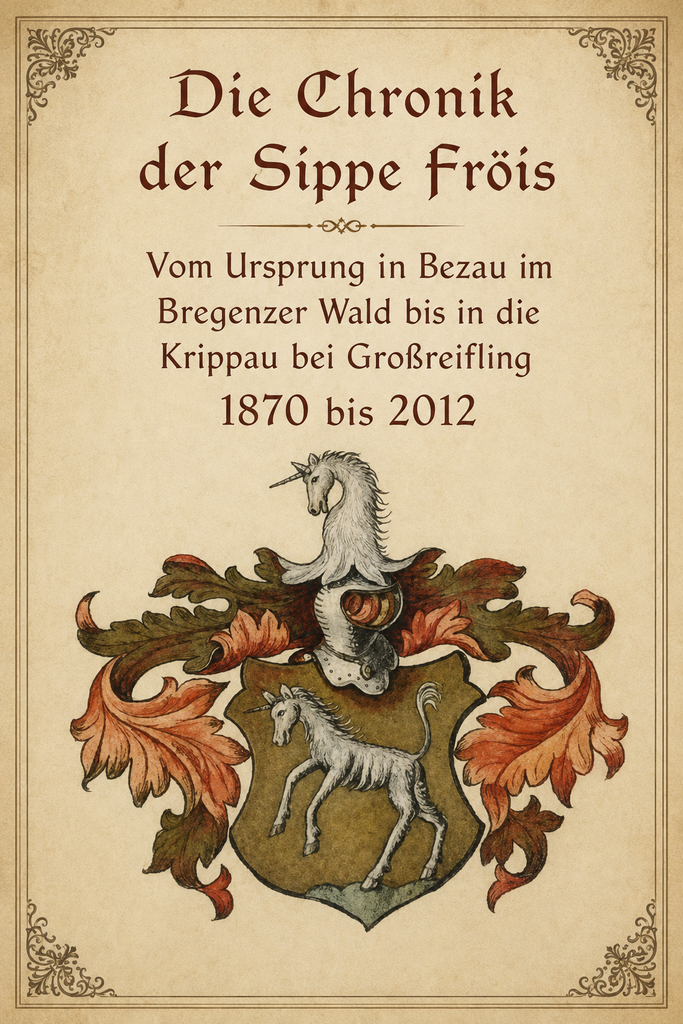
For me, it was an old family chronicle: Die Chronik der Sippe Fröis, documenting the family from its origins in Bezau in the Bregenzerwald to Krippau near Großreifling between 1870 and 2012.
At the centre of the book is a coat of arms.
A unicorn, a helmet, elaborate foliage and a shield in muted earth tones. At first glance, it looks like a relatively recent family emblem. But looking closer, the story leads much further back.
Following the name backwards
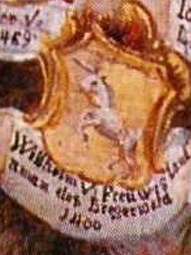
The oldest heraldic reference I have found so far is dated 1400.
The Fischnaler Wappenkartei of the Tiroler Landesmuseen records Fröis, Bregenzerwald (1400).
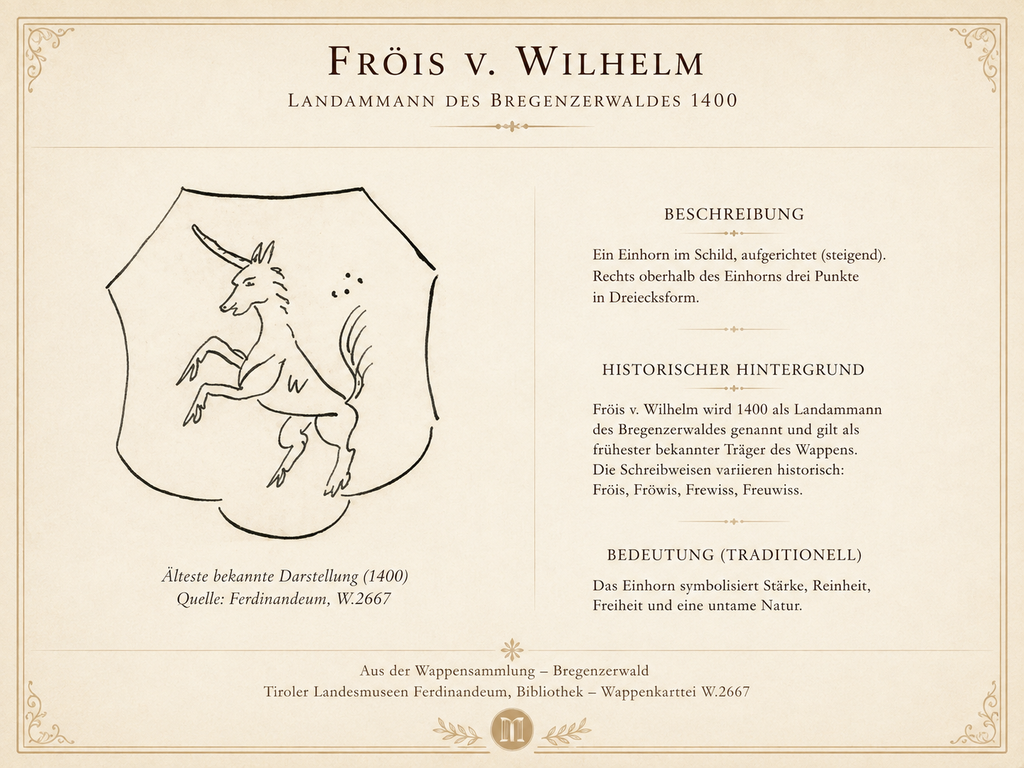
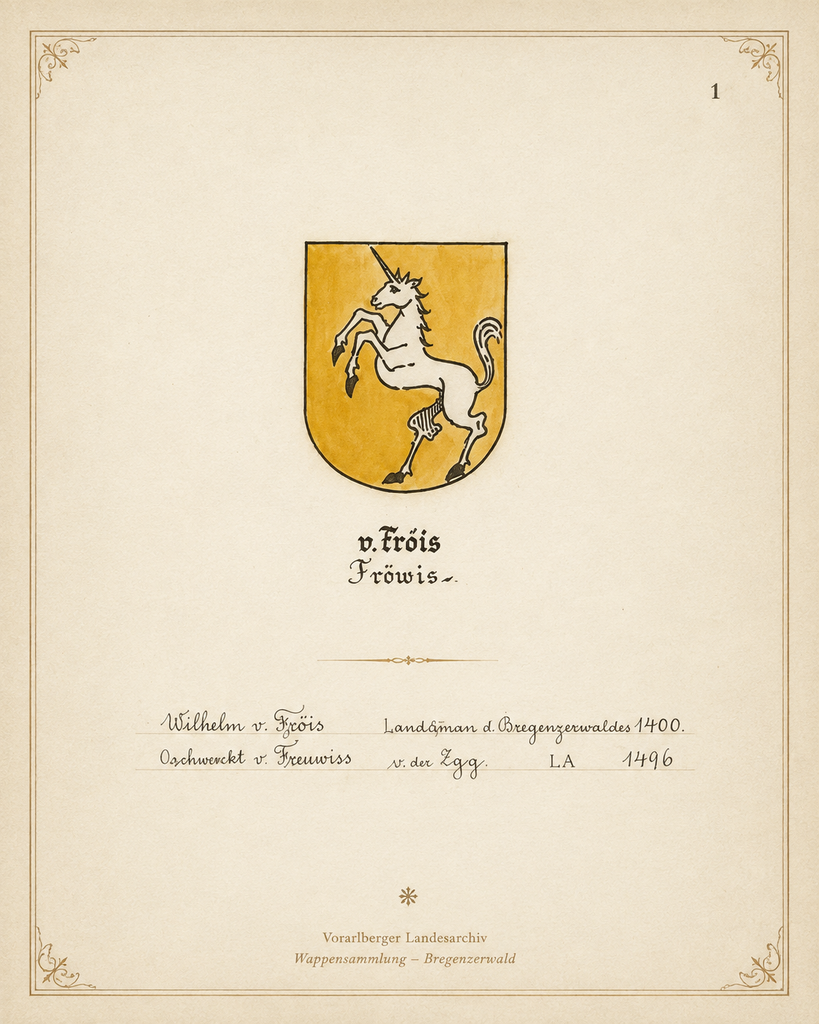
This date is particularly interesting because it corresponds with Wilhelm von Fröwis, who served as Landammann of the Bregenzerwald from around 1400. Historical sources also connect him with property in the region and with the Fröwis family that later became associated with Feldkirch.
The name itself appears in several historical spellings — Fröis, Fröwis, Frewiss, Freuwiss — something that is common when following medieval and early-modern family records.
The heraldic record therefore gives me a starting point, rather than a finished answer.
The unicorn
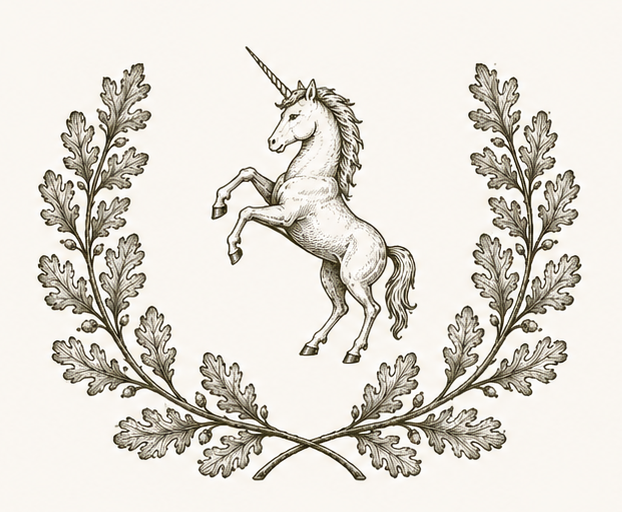
The most striking element of the later arms is the unicorn.
It appears twice: once as the principal figure on the shield and again above the helmet as the crest.
In European heraldry, the unicorn traditionally carries associations with strength, purity, independence and an untamed nature. It is not an animal that submits easily; its symbolism is connected with something difficult to capture or control.
Whether these meanings were specifically intended by the Fröis family is impossible to establish without a contemporary explanation. For this reason, I prefer to treat the symbolism as an interpretation rather than a historical fact.
Still, the choice is fascinating.
A unicorn is an unusual figure for a family connected with the Bregenzerwald — a landscape defined by mountains, forests, isolation and strong local communities.
The shield
The shield is rendered in an earthy olive-gold / ochre tone, carrying the pale unicorn.
The colours of the surviving historical representations need to be treated carefully. Heraldic colour notation and later painted reproductions are not necessarily identical, and the family chronicle itself is a much later representation.
What interests me more than assigning a fixed meaning to every colour is the overall visual language:
earth, metal, foliage and animal.
It feels almost like a landscape translated into heraldry.
The green-brown field recalls soil and woodland. The silver-white unicorn creates a strong contrast, while the warm reds and oranges of the mantling introduce the colour of autumn leaves, fire and aged pigment.
The helmet and mantling
Above the shield sits a helmet, from which the unicorn rises as the crest.
Surrounding it is an elaborate mantling of red, rust, ochre and green.
The mantling originally had a practical connection to medieval armour, representing cloth attached to the helmet. Over time it became one of the most decorative parts of heraldic art.
Here it almost becomes botanical.
The leaves curl outward from the centre like branches, making the rigid geometry of the shield feel much more organic.
A family symbol that became an object
What interests me most is not whether every element can be given one definitive meaning.
It is the fact that this image has survived through different periods, places and versions of the family.
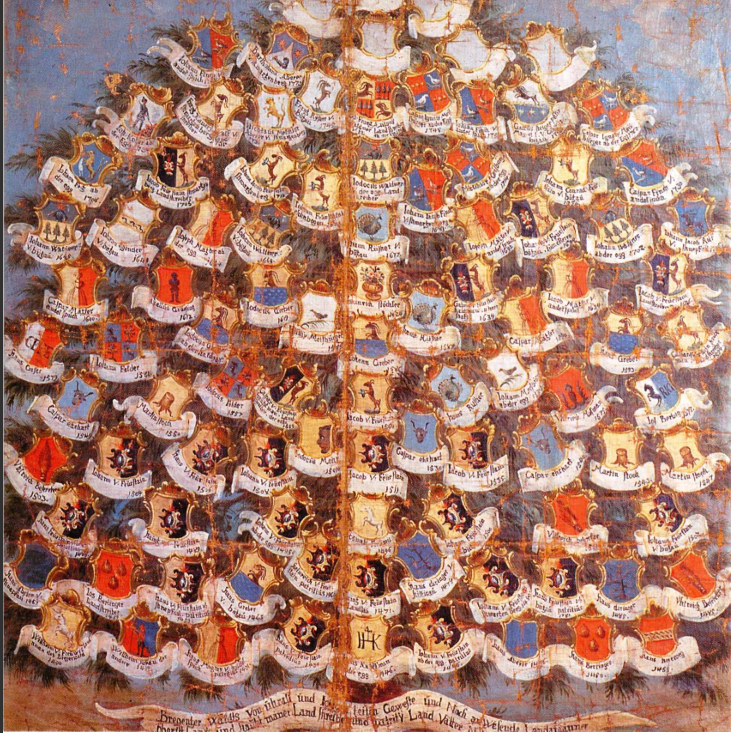
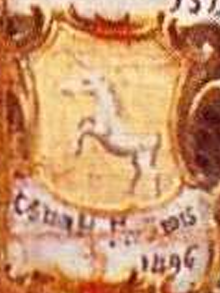
The Vorarlberg State Archives hold a collection of historical family arms from the Gunz collection, including Fröwis / Frewiss / Fröis / Freuwiss, and separately preserve a historical Landammänner-Wappentafel of the Bregenzerwald. The latter covers the Landammänner tradition from 1400 to 1773, with Fröis/Fröwis represented on the first page.
So the coat of arms is more than a decorative image in an old family book.
It has become a material trace of a place, a name and a lineage.
And this is where my own interest begins.
Rather than simply reproducing the arms, I want to understand how such an image changes when it passes from one generation to another — how symbols are remembered, redrawn, simplified, embellished and eventually interpreted by people who may no longer know exactly where they began.
For me, the coat of arms becomes another kind of field note:
a small image carrying centuries of information.
Sources / further research
The historical basis for this study comes primarily from the Vorarlberger Landesarchiv and the Tiroler Landesmuseen / Fischnaler Wappenkartei. The Landesarchiv’s collection specifically lists the Fröwis/Fröis family arms and identifies the historical Bregenzerwald Landammänner table as an important source.